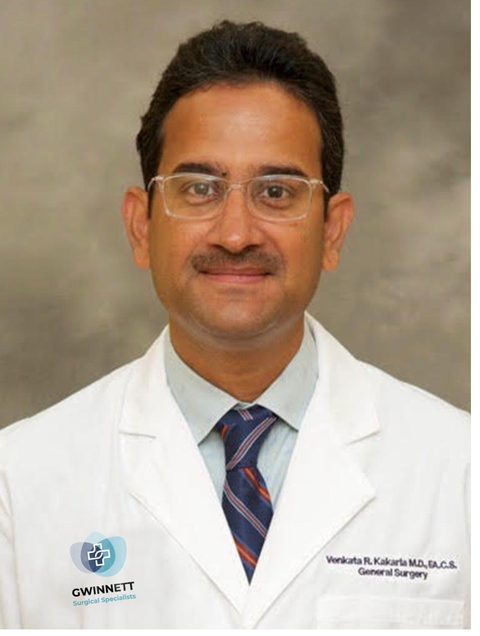
An inguinal hernia happens when part of the intestine or fatty tissue pushes through a weak spot in the lower abdominal wall, creating a bulge in the groin. It is the most common type of hernia, accounting for roughly 75 percent of all abdominal wall hernias. Men are about eight to ten times more likely to develop one than women.
Inguinal hernias do not go away on their own and often enlarge over time. While a small hernia may cause little discomfort, a larger one can become painful and potentially dangerous if intestine becomes trapped or loses its blood supply. That is why most surgeons recommend repair once a hernia is diagnosed — and why elective repair is generally safer and easier to recover from than emergency surgery.
Think You Might Have a Hernia?
Call us
Same-day and next-day appointments at our Lawrenceville office. No referral needed unless your insurance requires one. You do not need to see your PCP first or get testing done before your visit. Interpretation services available for all languages at our office and the hospital.
30-minute visit
Dr. Kakarla examines you, confirms the diagnosis (imaging if needed), and explains your options. The exam is brief and well tolerated.
Know your plan
Most patients leave knowing whether surgery is needed, where it will happen, and what to expect. We verify your insurance the same day.
Types of Inguinal Hernia
There are two main types, and the distinction matters for surgical planning:
More common
Indirect
Follows the path of the inguinal canal. Can occur at any age, including infants. Happens through a natural opening that did not fully close after birth.
Age-related
Direct
Pushes through a weakened area in the canal floor. Develops gradually due to aging, strain, or heavy lifting. More common in men over 40.
Some patients develop hernias on both sides (bilateral). Robotic surgery is particularly well-suited for bilateral repair — both sides fixed through the same small incisions in a single operation.
Recognizing the signs
What Does an Inguinal Hernia Feel Like?
The most common sign is a visible bulge on one or both sides of the groin. You may notice it more when you stand, cough, or strain.
- Dull ache or pressure in the groin that worsens with activity, lifting, or prolonged standing
- Burning or heavy sensation around the bulge
- Swelling into the scrotum in men — the bulge may extend downward
- Relief when lying down — the bulge flattens and discomfort improves
- No symptoms at all — some hernias are found during a routine physical exam
When to seek urgent care
Call our office first if your hernia becomes more painful, swollen, or harder to push back in — we can often evaluate you quickly and guide you on next steps. If you experience sudden, severe groin pain with a bulge that will not go back in, especially with nausea, vomiting, or fever, go to the emergency room or call 911. These may be signs of a strangulated hernia, which requires emergency surgery.
I noticed a small bulge while exercising and tried to ignore it for months. By the time I saw Dr. Kakarla, it had doubled in size. He told me most patients say they wish they had come in sooner — and after how easy the recovery was, I understand why.
— Verified Google ReviewGetting answers
How Inguinal Hernias Are Diagnosed
In most cases, Dr. Kakarla can diagnose an inguinal hernia with a physical exam during your office visit. You will be asked to stand and cough or bear down while the groin area is examined. The exam takes just a few minutes and is usually brief and well tolerated.
For hernias that are not obvious on exam — or to evaluate the size and plan the surgical approach — imaging may be ordered:
- Ultrasound — often the first imaging test, useful for confirming small or uncertain hernias
- CT scan — provides detailed information about hernia size, contents, and anatomy. Especially helpful for recurrent hernias or surgical planning
Women with a groin bulge or groin pain need careful evaluation because femoral hernias — which are more common in women — carry a higher risk of incarceration and may require prompt repair.
Coming for a second opinion? Please bring your imaging (CT or ultrasound on CD or through a patient portal) and any relevant lab work. Having these available at your first visit allows Dr. Kakarla to review your case thoroughly and discuss a plan the same day.
Understanding your risk
Causes and Risk Factors
A hernia develops when there is a weak spot in the abdominal wall combined with enough pressure to push tissue through it.
Cannot change
- Male sex — 8–10× higher risk
- Age — tissue weakens over time
- Family history — hernias run in families
- Prior hernia — increases likelihood
Can address
- Chronic cough — from smoking or COPD
- Straining — constipation, heavy lifting
- Obesity — increases abdominal pressure
- Smoking — impairs tissue healing
Learn more about hernia risk factors and practical steps to reduce your risk.
Your treatment options
How Inguinal Hernias Are Repaired
Surgery is the only way to permanently fix an inguinal hernia — there is no brace, medication, or exercise that can close the opening. In select patients with very small, minimally symptomatic hernias and significant medical risk factors, watchful waiting with regular monitoring may be a reasonable short-term option. However, hernias tend to enlarge over time, and elective repair when you are healthy carries significantly lower risk than emergency repair. Dr. Kakarla discusses your options and decides together with you on the best approach.
Hernia belts and trusses provide temporary symptom relief by holding the hernia in place — similar to a bandaid over a wound. They do not repair the hernia and are not a substitute for surgery. Dr. Kakarla generally recommends hernia belts only for patients who cannot safely undergo anesthesia and surgery due to severe medical conditions.
The three main surgical approaches are:
Robotic Hernia Repair
Dr. Kakarla operates through three to four small incisions (each about 8 mm) using the da Vinci system with 3D magnified visualization and wristed instruments. See the full advantages of robotic repair below ↓
Dr. Kakarla's preferred approachLaparoscopic Repair
Uses small incisions and a camera without robotic assistance. A well-established approach offering similar recovery advantages. Compare robotic vs. laparoscopic →
Open Repair
A larger incision directly over the hernia. May be appropriate for very small hernias or patients who cannot have general anesthesia. Compare all approaches →
Bilateral Check
During every robotic inguinal hernia repair, Dr. Kakarla evaluates both sides of the groin. If a clinically meaningful hernia is found on the opposite side — even one too small to detect on physical exam — repair may be offered through the same small incisions during the same operation, avoiding a second surgery. This possibility is discussed and consented before your procedure. A bilateral repair typically does not significantly increase recovery time or out-of-pocket costs, as it uses the same incisions and anesthesia.
Mesh Reinforcement
Most adult inguinal hernia repairs use a lightweight synthetic mesh to reinforce the weakened area. Research consistently shows that mesh repair has significantly lower recurrence rates (1–3%) than suture-only repair (10–15%). In rare cases — such as a very small indirect hernia in a young patient — suture-only repair may be considered. If you have strong concerns about mesh, Dr. Kakarla will discuss your options.
Dr. Kakarla commonly uses an anatomically contoured polypropylene mesh selected specifically for the inguinal canal:
- Three-dimensional, pre-formed shape — conforms to the natural curvature of the groin without buckling, unlike flat mesh that must be trimmed during surgery
- Designed for fixation-free placement — in many cases, the contoured shape holds position without tacks or staples, which may contribute to less post-operative discomfort
- Monofilament polypropylene with large pores — designed to allow your tissue to grow through the mesh while reducing the risk of bacteria harboring in the material
- Clinical data — in a controlled study of 500 repairs, recurrence rates were below 1% with very low rates of chronic pain
Note: Mesh concerns in the media were primarily about vaginal mesh products — a completely different device used for a different purpose. Hernia mesh has a long safety record and remains the standard of care endorsed by all major surgical societies.
The robotic advantage
Why Robotic Surgery?
- 3D magnified visualization — the surgeon sees the anatomy in high-definition depth, not on a flat 2D screen
- Wristed instruments with 7 degrees of freedom — move with greater range than the human hand, enabling precise work in the tight inguinal canal
- Less tissue disruption — meticulous dissection means less bruising, less blood loss, and less post-operative inflammation
- Mesh placed between abdominal wall layers — the ability to suture precisely inside the abdomen allows mesh placement without sutures through muscle, which translates to less pain and lower chance of nerve irritation
- Bilateral repair through the same incisions — both sides evaluated and repaired in one operation if needed
- Better outcomes for older and complex patients — smaller incisions and reduced tissue trauma mean patients who might not tolerate traditional open surgery can safely undergo robotic repair. Robotic techniques have changed the equation for elderly patients with medical conditions — many who would have been told to live with their hernia can now safely undergo repair with fewer complications than an enlarging hernia would eventually cause
- Tremor filtration and motion scaling — the system filters natural hand tremor and can scale movements for sub-millimeter precision
Your surgeon
Why Dr. Kakarla?
- 2,500+ robotic procedures — among the highest volume in the region, well beyond the learning curve where outcomes plateau
- Surgical experience across three continents — this international breadth across open, laparoscopic, and robotic techniques has refined Dr. Kakarla's approach, allowing him to draw on a wider range of techniques than surgeons trained in a single system
- Fellowship-trained in minimally invasive and robotic surgery at the University of Illinois at Chicago
- Board certified by the American Board of Surgery
- Tailored approach for every patient — Dr. Kakarla selects the technique (robotic, laparoscopic, or open) based on your hernia type, anatomy, and medical history — not a one-size-fits-all protocol. Experience across multiple techniques means the choice is always made for your benefit, not limited by the surgeon's skill set
- Multimodal pain management — ERAS-based protocol (enhanced recovery using multiple non-opioid strategies) with intraoperative TAP block, minimizing opioid use
- Same-day and next-day consultations — rapid access without long waits
Your surgical locations
Where Your Surgery Happens
Most robotic inguinal hernia repairs are performed as outpatient procedures at the Northside Gwinnett Outpatient Surgery Center — a modern, purpose-built facility on the Northside Hospital Gwinnett campus in Lawrenceville. You arrive in the morning and go home the same day.
Where you have surgery
Northside Gwinnett Outpatient Surgery Center
2200 Medical Center Blvd, Suite 100
Lawrenceville, GA 30046
Parking: Level P1 in the parking garage (2200 Building). Enter the building — the surgery center is directly ahead.
Discharge: Designated pickup spot on P1 garage level. A Northside associate will bring you to your ride.
Where you are seen for consultation
Gwinnett Robotic & Hernia Surgery
631 Professional Drive, Suite 300
Lawrenceville, GA 30046
Phone: (770) 962-9977
Hours: Mon–Thu 7 am–4:30 pm · Fri 7–11 am
Ready to schedule? Same-day and next-day appointments available.
Before your procedure
Preparing for Surgery Day
While You Wait for Surgery
Between your consultation and your surgery date, follow these guidelines to keep your hernia stable:
- Restrict activity appropriately — avoid heavy lifting, straining, or anything that worsens the bulge or discomfort
- Support the hernia when coughing, sneezing, or bearing down — place the palm of your hand over the hernia area to provide gentle counter-pressure
- If the bulge increases, try gentle manual reduction — lie on your back and use steady, gentle pressure to push the bulge back in. Do not force it.
- Call our office if the hernia becomes painful, hard, or will not push back in, or if you develop nausea or vomiting — these may be signs of incarceration requiring urgent evaluation
Optimizing Your Health Before Surgery
The weeks before surgery are an opportunity to prepare your body for the best possible outcome:
- Stop smoking — smoking impairs wound healing, increases infection risk, and slows recovery. Stopping at least 2–4 weeks before surgery significantly improves outcomes. Ask our office about cessation resources.
- Stay active — continue walking and light exercise within the limits of your hernia symptoms. Patients who are physically active before surgery recover faster.
- Eat a high-protein diet — protein is essential for tissue repair and healing. Include lean meats, fish, eggs, dairy, beans, and nuts in your meals in the weeks leading up to surgery.
Once your surgery is scheduled, our office provides detailed instructions. You will also receive a phone call from the surgery center 1–2 days before your procedure with your specific arrival time and any final details. Here is what to expect:
Anesthesia
Robotic inguinal hernia repair is performed under general anesthesia — you will be fully asleep and will not feel anything during the procedure. A board-certified anesthesiologist manages your anesthesia and monitors you throughout surgery. You do not need to arrange your own anesthesia consultation — this is handled on the day of surgery.
The Night Before
- No solid food after midnight the night before surgery. You may be permitted to drink clear liquids (water, black coffee, apple juice without pulp) up to 2 hours before your procedure per ASA fasting guidelines — the surgery center will confirm the exact cutoff time when they call you. Follow the specific instructions you receive, as they are based on your surgery time.
- Medications: Dr. Kakarla will tell you which medications to take the morning of surgery with a small sip of water and which to hold.
- Blood thinners and antiplatelet medications: If you take any blood-thinning or antiplatelet medication, you will receive specific stop and restart instructions from our office. Common medications and typical guidance:
- Warfarin (Coumadin) — typically stopped 5 days before surgery; INR checked the day before. Bridging with injectable blood thinner may be needed for high-risk patients — confirm the plan with your cardiologist
- Eliquis (apixaban), Xarelto (rivaroxaban), Pradaxa (dabigatran), Savaysa — typically stopped 1–3 days before surgery depending on kidney function and bleeding risk. No bridging needed
- Plavix (clopidogrel) — stopped 5–7 days before; Brilinta (ticagrelor) — stopped 3–5 days before; Effient (prasugrel) — stopped 7 days before
- Aspirin — may be continued or stopped depending on why you take it. If prescribed for a prior heart attack, stent, or stroke, it may be continued. If taken for general prevention only, it is usually stopped 5–7 days before
- GLP-1 weight loss or diabetes medications (Ozempic, Wegovy, Mounjaro, Trulicity, Saxenda, Rybelsus, and similar): These medications slow stomach emptying, which increases anesthesia risk. Current hospital protocol requires stopping these medications one week before surgery and following a liquid-only diet the day before surgery. Inform our office when scheduling if you take any of these medications so we can coordinate the timeline.
- No need to shave the surgical area — the surgical team handles any hair removal needed.
- Shower the evening before or morning of surgery with regular soap.
What to Bring and Wear
Bring with you
- Photo ID (driver's license or state ID)
- Insurance card
- List of current medications
- Any required co-pay
- Phone and charger
Wear / plan for
- Loose, comfortable clothing (elastic waist pants, slip-on shoes)
- Leave jewelry, watches, and valuables at home
- No contact lenses — wear glasses instead
- No nail polish or makeup
Transportation
You may drive yourself to the surgery center, but you must have someone to drive you home after the procedure. General anesthesia impairs judgment, coordination, and reflexes for at least 24 hours. You also need someone to stay with you the first night after surgery. Plan this in advance — the surgery center will confirm your ride-home plan before your procedure.
Work Paperwork
If you need documentation for your employer (work excuse, FMLA forms, disability paperwork), let the office know in advance. Paperwork can be completed before surgery or at your post-operative visit.
The day of your procedure
What Happens on Surgery Day
About general anesthesia
It is normal to feel groggy, mildly nauseous, or "foggy" for the rest of the day after general anesthesia. Do not drive, operate machinery, make important decisions, or drink alcohol for 24 hours. These effects are temporary and resolve fully by the next morning for most patients.
After your surgery
Recovery Timeline
Most patients are surprised by how manageable the recovery is after robotic inguinal hernia repair. The TAP block performed during surgery provides significant pain relief for the first 12–24 hours, giving you a head start on recovery.
See our detailed recovery guide for additional tips and information.
Multimodal pain management
Dr. Kakarla uses an ERAS-based (enhanced recovery protocol using several non-opioid pain strategies) multimodal approach. It starts with the TAP block performed during surgery, combined with scheduled acetaminophen and ibuprofen after surgery. Most patients manage their recovery with over-the-counter medication alone.
When to call after surgery
Call our office first for: fever over 101.5°F · worsening redness, swelling, or drainage from incisions · inability to urinate · severe pain not controlled by medication · nausea or vomiting preventing you from keeping fluids down · rapidly increasing scrotal swelling · a bulge that is hard, painful, and will not go back in. We can often evaluate you quickly and advise on next steps.
Call 911 for: chest pain or difficulty breathing · fainting · new calf or leg swelling with pain.
For routine questions or non-urgent concerns, call (770) 962-9977 during office hours.
Common Activity Questions
- Stairs — immediately, take it slow and hold the railing
- Driving — when off narcotic pain medication and comfortable performing an emergency stop (typically day 5–7)
- Groceries — after week 1, keep bags under 10 lbs
- Desk work — many patients return within 1–2 weeks, depending on pain control, commute, and job demands
- Physical labor — 4–6 weeks, with gradual return
- Walking / light exercise — encouraged from day 1 and gradually increased
- Gym / weight training — after 4 weeks, start light and increase gradually
- Golf, tennis, running — typically 4–6 weeks
- Sexual activity — when comfortable, typically 2–3 weeks
- Constipation — milk of magnesia prescribed; stay hydrated, eat fiber, walk daily
Some patients with recurrent hernias, prior pelvic or prostate surgery, large scrotal hernias, or significant medical conditions may require individualized surgical planning and recovery timelines — discuss your specific situation at your consultation.
I was back at my desk in 8 days. Honestly, the anticipation was worse than the actual recovery. By day 4 I was walking around the neighborhood and only taking Tylenol.
— Verified Google ReviewUnderstanding the risks
Possible Risks and Complications
Inguinal hernia repair is one of the most commonly performed and well-studied operations in surgery. Serious complications are uncommon, but no surgery is risk-free. Possible risks include:
- Bleeding — rare; usually minor and self-limited
- Infection — uncommon with minimally invasive technique; reduced further by Dermabond antimicrobial closure
- Seroma or hematoma — fluid or blood collection at the surgical site; usually resolves on its own
- Urinary retention — temporary difficulty urinating after general anesthesia; uncommon
- Scrotal or testicular swelling — common in men and usually resolves over 2–4 weeks
- Chronic groin pain — persistent discomfort beyond 3 months occurs in approximately 2–5% of patients; most cases are mild
- Numbness — temporary numbness near the incisions or groin is common; occasionally persistent
- Mesh-related complications — rare; may include mesh infection or mesh migration requiring additional treatment
- Recurrence — the hernia returning after repair; occurs in 1–3% of mesh repairs
- Injury to nearby structures — rare injury to bowel, bladder, blood vessels, spermatic cord, or nerves
- Conversion to open surgery — in rare cases, the operation may need to be completed through a larger incision for safety
- Anesthesia risks — rare complications related to general anesthesia, discussed with your anesthesiologist
Dr. Kakarla discusses your individual risk profile during your consultation. The specific risks, benefits, and alternatives for your situation are reviewed before you consent to surgery.
This information is general and may not apply to every patient. Your own risks, benefits, and recovery plan will be discussed with you in person before surgery.
Practical details
Inguinal Hernia Surgery Cost and Insurance
Robotic inguinal hernia repair is a standard, well-established procedure covered by virtually all insurance plans:
- Medicare and Medicaid — typically covered, subject to your plan rules and patient responsibility (deductible, copay, coinsurance)
- Commercial insurance — Aetna, Anthem/BCBS, Cigna, Humana, UnitedHealthcare, Tricare, and most other major plans
- We verify your benefits before scheduling — our office contacts your insurer so you know your out-of-pocket cost upfront
- No extra charge for robotic technology — insurance reimburses the same procedure codes regardless of surgical approach
- No referral needed unless your specific insurance plan requires one
Your out-of-pocket cost depends on your plan's deductible, copay, and coinsurance. If cost is a concern, our office staff can walk you through your benefits and discuss options. See full insurance information →
Common questions
Frequently Asked Questions
Do all inguinal hernias need surgery?
Most symptomatic inguinal hernias should be repaired. For patients with very small, painless hernias and significant medical risks, a careful watch-and-wait approach may be discussed. However, hernias tend to enlarge over time and the risk of emergency complications increases with delay, so most surgeons recommend elective repair when the patient is healthy enough for surgery.
Can an inguinal hernia heal on its own?
No. An inguinal hernia is a physical opening in the abdominal wall that cannot close by itself. Exercises, braces, and trusses may provide temporary comfort but do not fix the hernia. The only cure is surgical repair.
Will I need mesh?
In the vast majority of cases, yes. Lightweight synthetic mesh reinforces the repair and reduces recurrence to 1–3%, compared to 10–15% with suture-only repair. The mesh used today is thin, flexible, and well-tolerated. Concerns in the media were primarily about vaginal mesh products — hernia mesh has a long safety record and remains the standard of care.
When can I go back to work?
Most patients with desk jobs return within one to two weeks. Jobs involving heavy lifting or strenuous activity require four to six weeks. Dr. Kakarla provides personalized guidance and a work note at your follow-up visit.
How much pain should I expect?
Most patients describe mild to moderate soreness, similar to a pulled muscle. Dr. Kakarla's multimodal approach often allows patients to manage with over-the-counter acetaminophen and ibuprofen rather than opioids. Most patients are pleasantly surprised by how manageable the recovery is.
What happens at my first appointment?
Dr. Kakarla examines your groin area, confirms the diagnosis, and discusses your options in detail. The exam takes a few minutes and is usually brief and well tolerated. You will have plenty of time to ask questions. Most patients know their surgical plan before they leave. The entire visit typically takes 30–45 minutes. You are welcome to bring a family member or friend.
Is robotic surgery covered by insurance?
Yes. Robotic inguinal hernia repair is covered by Medicare, Medicaid, and virtually all major commercial insurance plans. The procedure codes are the same whether the operation is performed robotically, laparoscopically, or open — you are not charged extra for the robotic technology. Our office verifies your benefits before scheduling.
What if my hernia comes back after surgery?
Recurrence after robotic mesh repair is uncommon — roughly 1–3%. If a hernia does recur, it can be repaired again. Dr. Kakarla has extensive experience with recurrent hernia repair and evaluates complex cases from across Georgia.
Will I be asleep during surgery?
Yes. Robotic inguinal hernia repair is performed under general anesthesia — you will be completely asleep and will not feel anything. A board-certified anesthesiologist monitors you throughout the procedure. Most patients wake up with minimal pain thanks to the TAP block administered during surgery.
Do I need to shave before surgery?
No. Do not shave the surgical area yourself — this can cause small nicks that increase infection risk. The surgical team handles any necessary hair removal with medical-grade clippers immediately before the procedure.
Will I have stitches to remove?
No. Dr. Kakarla closes the incisions with Dermabond — a medical-grade skin adhesive that forms a waterproof, antimicrobial barrier. It naturally sloughs off in 5–10 days. There are no stitches, staples, or sutures to remove and no follow-up visit needed just for wound care.
When can I shower after surgery?
You can take a brief shower the same day as surgery — the Dermabond adhesive is water-resistant. However, do not soak in a bath, hot tub, or pool, and do not scrub or pick at the incisions until the Dermabond has sloughed off naturally (5–10 days).
What if you find a hernia on the other side during surgery?
Dr. Kakarla routinely inspects both sides of the groin during every robotic inguinal hernia repair. If a hernia is found on the opposite side — even a small one not detected on physical exam — it can be repaired through the same small incisions during the same operation. This is discussed and consented before surgery so you are prepared for the possibility.
I've seen TV ads about hernia mesh lawsuits. Should I be concerned?
The mesh lawsuits you see advertised primarily involve older-generation mesh products that are no longer in use, as well as vaginal mesh products — a completely different device used for a different purpose. Modern hernia mesh like the anatomically contoured polypropylene mesh Dr. Kakarla uses has been refined significantly in design, material weight, and pore structure. It remains the standard of care endorsed by all major surgical societies, with decades of safety data supporting its use in inguinal hernia repair.
Do I need a referral or to see my PCP first?
No. You can call our office directly to schedule an evaluation. You do not need to see your primary care doctor first, and you do not need any testing done before your visit — unless your specific insurance plan requires a referral.
Questions to bring to your consultation
- Which surgical approach do you recommend for my hernia, and why?
- How many of these repairs do you perform each year?
- What type and size of mesh will you use?
- What is the expected recovery timeline for my specific situation?
- What are the risks, and how do you minimize them?
- What is the recurrence rate with your technique?
- When can I return to my specific job/sport/activity?
- What pain management approach do you use?
- What will my out-of-pocket cost be after insurance?
Does inguinal hernia repair affect fertility or sexual function?
I’m pregnant and have an inguinal hernia. When should it be fixed?
My teenager has a groin hernia. Is the treatment different?