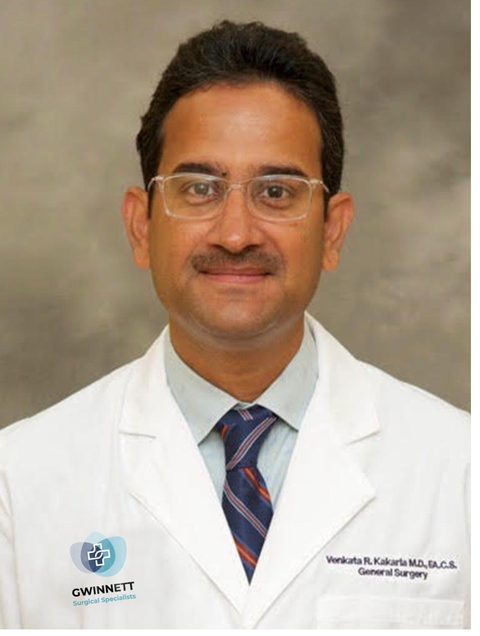
A ventral hernia is a bulge through a weakness or opening in the front wall of the abdomen. Umbilical hernias (sometimes called belly button hernias), incisional hernias (at a prior surgical scar), and epigastric hernias (between the navel and breastbone) are all types of ventral hernia. Surgery is the only way to permanently repair them — there is no brace, medication, or exercise that can close the opening.
Ventral hernias are among the most common conditions Dr. Kakarla treats. They range from small umbilical hernias that can be repaired in 30 minutes to complex incisional hernias requiring abdominal wall reconstruction. Dr. Kakarla tailors the approach — open, laparoscopic, or robotic — to the size, location, and complexity of your hernia.
Have a Bulge in Your Abdomen? Here’s What Happens Next
Call us directly
No referral needed unless your insurance requires one. You do not need to see your PCP first or get testing done before your visit. Same-day and next-day appointments available. Interpretation services available for all languages.
30-minute evaluation
Dr. Kakarla examines the hernia, reviews any imaging, and explains your surgical options. Most hernias can be diagnosed by physical exam alone.
Scheduled quickly
Surgery is typically scheduled within 1–2 weeks. We verify your insurance and you know your out-of-pocket cost before the procedure.
Understanding your hernia
Types of Ventral Hernia
- Umbilical hernia — a bulge at or near the navel. The most common type in adults. Often develops gradually from increased abdominal pressure (obesity, pregnancy, heavy lifting, chronic cough). Present from birth in some patients
- Incisional hernia — develops at the site of a previous surgical incision. Can occur months to years after any abdominal surgery (C-section, appendectomy, laparotomy, prior hernia repair). Occurs in approximately 10–15% of abdominal surgeries
- Epigastric hernia — a small bulge in the midline between the navel and breastbone. Usually contains fat rather than intestine
- Spigelian hernia — a rare hernia through the lateral abdominal wall. Can be difficult to diagnose on exam alone and may require CT imaging
- Recurrent hernia — a hernia that returns after a prior repair. Dr. Kakarla has extensive experience with recurrent hernias from other surgeons, where the robotic platform’s precision is especially valuable in scarred tissue
Diastasis recti is a separation of the abdominal muscles, not a true hole in the abdominal wall. It can cause visible bulging but does not carry the same risk of incarceration or strangulation as a true hernia. Diastasis sometimes accompanies ventral hernias. Dr. Kakarla can evaluate whether a diastasis requires surgical repair during your consultation.
Recognizing the signs
Symptoms of a Ventral Hernia
- Visible bulge — most noticeable when standing, straining, or coughing. May flatten when lying down
- Pain or discomfort — aching, pulling, or pressure at the hernia site, especially with activity or at the end of the day
- Pain with lifting, straining, or prolonged standing
- Sensation of heaviness or dragging in the abdomen
- Nausea or vomiting — if bowel becomes trapped (incarceration)
Some ventral hernias cause no symptoms at all and are discovered incidentally on imaging or during an exam. However, hernias tend to enlarge over time, and elective repair when you are healthy carries significantly lower risk than emergency repair.
When to seek urgent care
Call our office first if your hernia becomes more painful, larger, or harder to push back in — we can often evaluate you quickly and guide you on next steps. If the hernia is suddenly painful, firm, and will not push back in, especially with nausea, vomiting, or fever, go to the emergency room or call 911. These may be signs of incarceration or strangulation requiring emergency surgery.
Getting answers
How Ventral Hernias Are Diagnosed
Most ventral hernias are diagnosed by physical examination. Dr. Kakarla examines the abdomen while you stand and strain to make the hernia visible. Additional testing may include:
- CT scan of the abdomen — ordered for larger or complex hernias to measure the defect size, identify the hernia contents, evaluate for multiple defects, and plan the surgical approach. Essential for recurrent and incisional hernias
- Ultrasound — occasionally used for small hernias that are difficult to feel on exam
Your treatment options
How Ventral Hernias Are Repaired
Surgery is the only permanent fix. Hernias do not heal on their own, and abdominal binders provide temporary symptom relief but do not repair the defect.
Not every ventral hernia needs immediate repair. Small, minimally symptomatic hernias may sometimes be monitored with regular check-ups, especially if surgical risk is high. However, hernias tend to enlarge over time, and elective repair when you are healthy carries significantly lower risk than emergency repair. Surgery is usually recommended when the hernia enlarges, causes pain, limits activity, or is at risk of incarceration. The approach is discussed and decided together with you based on hernia size, location, complexity, and your medical history:
Robotic Hernia Repair
Dr. Kakarla’s preferred approach for most ventral hernias. Through 3 small incisions on the side of the abdomen, the da Vinci system provides 3D magnified visualization and wristed instruments. The hernia contents are reduced, the defect is closed with sutures, and mesh is placed for reinforcement — all without a large incision over the hernia.
Dr. Kakarla’s preferred approachOpen Repair
An incision directly over the hernia. Used for very small hernias (less than 1 cm) where the defect can be closed with sutures and mesh through a small incision, or for very large or complex hernias requiring abdominal wall reconstruction with component separation.
Component Separation / Abdominal Wall Reconstruction
For large or complex hernias where the abdominal wall muscles have pulled apart significantly, the muscles are released and advanced to close the defect — essentially rebuilding the abdominal wall. Very large hernias can stretch the abdominal wall so much that the abdominal contents no longer fit normally inside the abdomen (a condition called “loss of domain”). These patients may need abdominal wall reconstruction to restore the integrity of the abdominal wall. This is a more extensive procedure typically reserved for large incisional hernias, recurrent hernias, or hernias with significant loss of domain.
Mesh Reinforcement
Most ventral hernia repairs use mesh to reinforce the repair and reduce recurrence. Without mesh, recurrence rates are significantly higher. Dr. Kakarla uses a composite mesh — a flat, three-dimensional polyester mesh with an absorbable collagen barrier on one side:
- Collagen barrier — the absorbable film prevents the mesh from adhering to internal organs when placed inside the abdomen
- Three-dimensional polyester structure — provides long-term reinforcement and promotes tissue integration on the abdominal wall side
- Pre-placed sutures — facilitate precise, efficient fixation during surgery
- Available in multiple shapes and sizes — selected to match your specific defect
Mesh concerns in the media primarily involve vaginal mesh products — a completely different device. Hernia mesh has a long safety record and remains the standard of care endorsed by all major surgical societies.
What Surgery May and May Not Fix
Hernia repair is intended to correct the bulge and reduce hernia-related pain or pressure. It may not fully resolve every abdominal symptom, especially if symptoms also relate to constipation, bloating, scar tissue, or other digestive conditions. Dr. Kakarla evaluates your symptoms carefully to set realistic expectations.
The robotic advantage
Why Robotic Ventral Hernia Repair?
- No incision over the hernia — the 3 small port incisions are placed on the side of the abdomen, away from the hernia. This avoids cutting through the weakened tissue and reduces wound complications
- 3D magnified visualization — the surgeon sees the defect and surrounding anatomy in high-definition depth
- Wristed instruments — allow precise suturing of the defect closed and accurate mesh placement from inside the abdomen
- Less tissue disruption — smaller incisions mean less pain, less infection risk, and faster recovery
- May support a more durable repair — precise mesh placement and suture closure of the defect contribute to a well-reinforced repair
- Ideal for recurrent hernias — robotic precision is especially valuable when operating through scar tissue from prior repairs
- Tremor filtration and motion scaling — the system filters natural hand tremor for sub-millimeter precision
Your surgeon
Why Dr. Kakarla?
- 2,500+ robotic procedures — among the highest volume in the region, well beyond the learning curve where outcomes plateau
- Surgical experience across three continents — this international breadth across open, laparoscopic, and robotic techniques has refined Dr. Kakarla’s approach, allowing him to draw on a wider range of techniques than surgeons trained in a single system
- Extensive recurrent hernia experience — Dr. Kakarla repairs a high volume of failed hernias from other surgeons, where precision and judgment matter most
- Fellowship-trained in minimally invasive and robotic surgery at the University of Illinois at Chicago
- Board certified by the American Board of Surgery
- Tailored approach — Dr. Kakarla selects robotic, laparoscopic, or open technique based on your hernia size, location, and complexity
- Same-day and next-day consultations — rapid access without long waits
Your surgical locations
Where Your Surgery Happens
Most ventral and umbilical hernia repairs are performed as outpatient procedures — you arrive in the morning and go home the same day.
Robotic repair — standard cases
Northside Gwinnett Outpatient Surgery Center
2200 Medical Center Blvd, Suite 100
Lawrenceville, GA 30046
Small open repairs
Gwinnett Surgery Center
631 Professional Drive, Suite 300
Lawrenceville, GA 30046
Ready to schedule? Same-day and next-day appointments available.
Before your procedure
Preparing for Surgery
You will receive a phone call from the surgery center or hospital 1–2 days before your procedure with your specific arrival time and final instructions.
While You Wait for Surgery
- Support the hernia when coughing, sneezing, or straining — place your palm over the area for gentle counter-pressure
- Avoid heavy lifting and straining that worsens the bulge
- If the bulge increases, try gentle manual reduction — lie on your back and use steady, gentle pressure to push it back in. Do not force it
- Call our office if the hernia becomes painful, hard, or will not push back in
Optimizing Your Health Before Surgery
- Stop smoking — at least 2–4 weeks before surgery. Smoking significantly impairs wound healing and increases infection and recurrence risk. This is especially important for ventral hernia repair
- Weight management — excess abdominal weight increases pressure on the repair and raises recurrence risk. For significantly overweight patients whose hernia is currently manageable, Dr. Kakarla may recommend working with your primary care doctor on weight-loss strategies (including newer GLP-1 medications) before proceeding with surgery. Each case is evaluated individually
- Stay active — walking and light exercise within the limits of your hernia symptoms
- Eat a high-protein diet — protein is essential for tissue repair and healing
Anesthesia
Ventral hernia repair is performed under general anesthesia — you will be fully asleep. Very small open repairs may be performed under local anesthesia with sedation. A board-certified anesthesiologist manages your anesthesia throughout.
The Night Before
- No solid food after midnight. Clear liquids may be permitted up to 2 hours before — the surgery center will confirm
- Medications: Dr. Kakarla will specify which to take and which to hold
- Blood thinners and antiplatelet medications: If you take any blood-thinning or antiplatelet medication, you will receive specific stop and restart instructions from our office. Common medications and typical guidance:
- Warfarin (Coumadin) — typically stopped 5 days before surgery; INR checked the day before. Bridging with injectable blood thinner may be needed for high-risk patients — confirm the plan with your cardiologist
- Eliquis (apixaban), Xarelto (rivaroxaban), Pradaxa (dabigatran), Savaysa — typically stopped 1–3 days before surgery depending on kidney function and bleeding risk. No bridging needed
- Plavix (clopidogrel) — stopped 5–7 days before; Brilinta (ticagrelor) — stopped 3–5 days before; Effient (prasugrel) — stopped 7 days before
- Aspirin — may be continued or stopped depending on why you take it. If prescribed for a prior heart attack, stent, or stroke, it may be continued. If taken for general prevention only, it is usually stopped 5–7 days before
- GLP-1 medications (Ozempic, Wegovy, Mounjaro, etc.): Current hospital protocol requires stopping one week before surgery and a liquid-only diet the day before. Inform our office when scheduling
- No need to shave the surgical area
What to Bring and Wear
Bring with you
- Photo ID and insurance card
- List of current medications
- Co-pay if required
- Phone and charger
Wear / plan for
- Loose, comfortable clothing (elastic waist)
- Slip-on shoes
- Leave jewelry and valuables at home
- No contact lenses — wear glasses
Transportation
You may drive yourself to the surgery center, but you must have someone to drive you home and stay with you the first night. General anesthesia impairs judgment for 24 hours.
Work Paperwork
If you need employer documentation (work excuse, FMLA, disability forms), let the office know. Paperwork can be completed before surgery or at your post-operative visit.
The day of your procedure
What Happens on Surgery Day
After your surgery
Recovery Timeline
What Is Normal After Surgery
The following experiences are common and expected — they are not complications:
- Swelling or firmness at the hernia site — this is normal healing. The area may feel firm or lumpy for weeks as tissue remodels
- Seroma (fluid collection) — very common. The body fills the space where the hernia was. Usually absorbs on its own over weeks
- Temporary asymmetry — one side may look different from the other as swelling resolves
- Tightness when standing — the repair is holding the abdominal wall together more firmly than before. This improves over weeks
- Bruising — may extend beyond the incision sites. Normal and harmless
- Fatigue — especially the first 1–2 weeks. Naps are normal
Stay hydrated and eat fiber-rich foods to prevent constipation — straining can stress the repair, especially in the first few weeks.
Abdominal Binder
An abdominal binder (supportive wrap) is provided after surgery. Wear it when you are up and active for the first 4 weeks. You do not need to wear it while sleeping or resting. The binder supports the repair, reduces swelling, and improves comfort during recovery.
When to call after surgery
Call our office first for: fever over 101.5°F · worsening pain at the hernia site · increasing redness, swelling, or drainage from incisions · a new bulge at or near the repair site · inability to keep fluids down · severe bloating. We can often evaluate you quickly and advise on next steps.
Call 911 for: chest pain or difficulty breathing · fainting · sudden leg swelling with pain.
For routine questions, call (770) 962-9977 during office hours.
Common Activity Questions
- Driving — when off narcotic pain medication and comfortable (typically day 4–7)
- Desk work — most return within 1–2 weeks
- Physical labor — 4–6 weeks with gradual return
- Lifting — nothing over 10 lbs for 4 weeks
- Exercise — walking from day 1; gym/weights after 4 weeks with gradual increase
- Sexual activity — when comfortable and off prescription pain medication
- Showering — brief shower same day; no baths/pools until Dermabond sloughs off (5–10 days)
- Abdominal binder — wear when active for 4 weeks; remove for sleep
Multimodal pain management
Dr. Kakarla uses an ERAS-based (enhanced recovery using multiple non-opioid strategies) multimodal approach: TAP block during surgery, scheduled acetaminophen and ibuprofen after. Most patients manage recovery with over-the-counter medication alone.
Understanding the risks
Possible Risks and Complications
Ventral hernia repair is a common, well-studied operation. Serious complications are uncommon, but no surgery is risk-free:
- Seroma (fluid collection at the hernia site) — common, usually resolves on its own. The body naturally fills the space where the hernia was. Most seromas are harmless and absorb over weeks
- Hernia recurrence — can occur, especially in patients who are overweight, smoke, or have had multiple prior repairs. Risk is lower with mesh reinforcement and robotic technique
- Infection — uncommon with minimally invasive technique
- Bleeding or hematoma — usually minor and self-limited
- Chronic pain — uncommon; most patients have less pain after repair than before
- Mesh-related complications — rare; may include mesh infection or mesh migration
- Bowel injury — rare
- Blood clots — rare; early walking reduces risk
- Conversion to open surgery — uncommon with robotic technique
- Anesthesia risks — discussed with your anesthesiologist
Dr. Kakarla discusses your individual risk profile during consultation. Your specific risks, benefits, and alternatives are reviewed before you consent to surgery.
This information is general and may not apply to every patient. Your own risks, benefits, and recovery plan will be discussed with you in person before surgery.
Practical details
Hernia Surgery Cost and Insurance
- Medicare and Medicaid — typically covered, subject to your plan rules and patient responsibility (deductible, copay, coinsurance)
- Commercial insurance — Aetna, Anthem/BCBS, Cigna, Humana, UnitedHealthcare, Tricare, and most major plans
- We verify your benefits before scheduling — you know your out-of-pocket cost upfront
- No referral needed unless your specific insurance plan requires one
Common questions
Frequently Asked Questions
Do all ventral hernias need surgery?
Not all. Very small, asymptomatic ventral hernias may be monitored with regular check-ups (watchful waiting). However, hernias tend to enlarge over time, and elective repair when you are healthy carries significantly lower risk than emergency repair. Dr. Kakarla discusses your options and decides together with you on the best approach.
Can a ventral hernia heal on its own?
No. Unlike some childhood umbilical hernias, adult ventral hernias do not close on their own. The opening in the abdominal wall persists and typically enlarges over time. Surgery is the only permanent repair.
What is the difference between an umbilical hernia and a ventral hernia?
An umbilical hernia is a type of ventral hernia. “Ventral hernia” is the broad term for any hernia through the front wall of the abdomen — this includes umbilical (at the belly button), incisional (at a surgical scar), and epigastric (above the navel). The surgical approach depends on the type, size, and location of the hernia.
Will I need mesh?
Most ventral hernia repairs use mesh to reinforce the repair and significantly reduce the chance of recurrence. For very small defects, suture-only repair may be considered. Dr. Kakarla discusses mesh options during your consultation.
I had a hernia repaired before and it came back. Can it be fixed again?
Yes. Dr. Kakarla has extensive experience repairing recurrent hernias, including those from other surgeons. Recurrent repairs are more complex but the robotic platform’s precision is particularly valuable when working through scar tissue from prior operations.
What is the fluid collection or swelling I feel after surgery?
This is most likely a seroma — a collection of fluid in the space where the hernia was. Seromas are very common after ventral hernia repair and are not dangerous. The body naturally fills this space with fluid as it heals. Most seromas absorb on their own over several weeks. Only rarely is drainage needed.
Why do I need an abdominal binder?
The binder supports the repair, reduces swelling, and improves comfort during the first 4 weeks. Wear it when you are up and active. You do not need to wear it while sleeping or resting at home.
What happens at my first appointment?
Dr. Kakarla examines your hernia, reviews any prior imaging or surgical records, and explains your options. Most hernias are diagnosed by physical exam alone. If a CT scan is needed for surgical planning, it is ordered at that visit. The visit typically takes about 30 minutes.
Will I be asleep during surgery?
Robotic repairs are performed under general anesthesia. Very small open repairs may be done under local anesthesia with sedation. A board-certified anesthesiologist monitors you throughout. A TAP block provides long-lasting pain relief after you wake up.
How much pain should I expect?
Most patients describe mild to moderate soreness that improves over the first few days. Some bruising and swelling at the hernia site is normal. The TAP block provides significant relief for the first 12–24 hours. Most patients manage with Tylenol and ibuprofen.
Do I need to shave before surgery?
No. The surgical team handles any necessary hair removal with medical-grade clippers immediately before the procedure.
Will I have stitches to remove?
No. Incisions are closed with Dermabond medical skin adhesive, which naturally sloughs off in 5–10 days.
When can I shower after surgery?
Brief shower the same day is fine — the Dermabond is water-resistant. No baths, hot tubs, or pools until the adhesive has sloughed off (5–10 days).
I’ve seen TV ads about hernia mesh lawsuits. Should I be concerned?
The lawsuits primarily involve older-generation mesh products and vaginal mesh — a completely different device. Modern hernia mesh like the composite mesh Dr. Kakarla uses has been refined significantly and remains the standard of care endorsed by all major surgical societies.
I see negative stories online about hernia surgery. Should I be worried?
Patients who recover uneventfully — which is the vast majority — rarely post about their experience. Patients who have complications are far more likely to share their stories, creating a selection bias. Your outcome depends on your specific hernia, the surgical technique used, and the experience of your surgeon.
Do I need a referral or to see my PCP first?
No. You can call our office directly to schedule an evaluation. You do not need to see your primary care doctor first, and you do not need any testing done before your visit — unless your specific insurance plan requires a referral.
Questions to bring to your consultation
- How large is my hernia, and what approach do you recommend?
- Will this be robotic or open surgery?
- Will I need mesh?
- Is this an outpatient procedure or will I stay overnight?
- When can I return to my specific job?
- What are the chances of recurrence?
- I had a prior repair that failed — what will you do differently?
- What is my out-of-pocket cost after insurance?