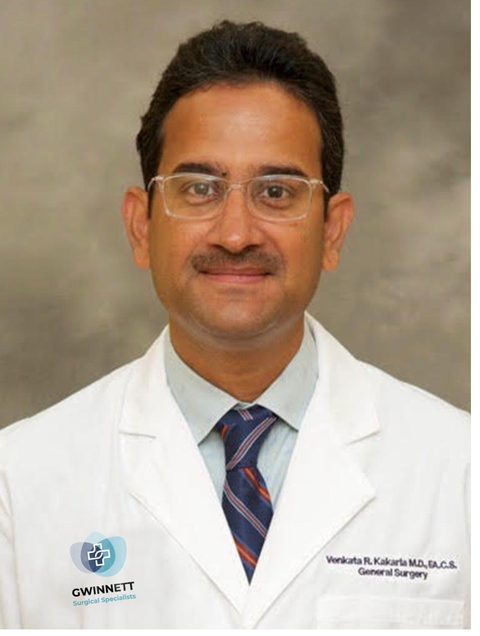
Dr. Kakarla provides acute care and emergency general surgery for patients in Gwinnett County and the surrounding communities. Whether you are experiencing acute appendicitis, an abscess that needs drainage, an acute abdomen, or another condition requiring urgent surgical evaluation, our office is available to help — with a 24/7 answering service and close coordination with local emergency departments.
Most patients with acute surgical conditions are first evaluated in the emergency room. ER physicians at Northside Hospital Gwinnett and surrounding hospitals consult Dr. Kakarla directly for urgent surgical evaluation. Patients may also call our office directly for same-day urgent appointments for conditions such as abscesses, acute anorectal problems, or worsening surgical conditions.
How to Reach Us
- Office hours: Call (770) 962-9977 — Mon–Thu 7 am–4:30 pm, Fri 7–11 am
- After hours, weekends, and holidays: Call the same number — our 24/7 answering service will connect you with Dr. Kakarla
- If you are in the ER: Let the ER team know you are Dr. Kakarla’s patient or would like him consulted
- True emergency: Go to the nearest emergency room or call 911
Interpretation services available for all languages at our office and the hospital.
Conditions We Treat Urgently
Appendicitis
Acute appendicitis is one of the most common surgical emergencies. Dr. Kakarla performs laparoscopic appendectomy through small incisions, typically taking 30 minutes to 1 hour. Most patients with uncomplicated appendicitis go home the same day or the next morning. Complicated cases (perforated or with abscess) may require a longer hospital stay and IV antibiotics.
Interval appendectomy: For patients whose appendicitis was initially treated with antibiotics and drainage (rather than immediate surgery), Dr. Kakarla performs elective appendectomy once the inflammation has resolved — typically 6–8 weeks later at Gwinnett Surgery Center as an outpatient procedure.
Abscess Drainage (I&D)
Skin abscesses, perianal abscesses, pilonidal abscesses, infected cysts, and other soft tissue infections that require incision and drainage. Depending on the size and location:
- Office-based I&D — smaller abscesses can be drained under local anesthesia at our office, often the same day you call
- Surgery center I&D — larger or deeper abscesses that require sedation or general anesthesia are performed at Gwinnett Surgery Center
Exploratory Surgery
When the cause of an acute abdominal condition is unclear or requires direct surgical intervention, Dr. Kakarla performs laparoscopic or open exploratory surgery at Northside Hospital Gwinnett. Common indications include:
- Small bowel obstruction — blocked intestine from adhesions (scar tissue), hernias, or other causes
- Perforated viscus — a hole in the stomach, intestine, or other organ causing infection in the abdomen
- Internal hernia — intestine trapped through an internal opening
- Acute abdomen — severe abdominal pain requiring urgent surgical evaluation when the diagnosis is not clear from imaging alone
- Gastrointestinal bleeding — when endoscopy and interventional radiology cannot control the source
- Complicated diverticulitis — perforation, abscess, or peritonitis requiring urgent surgery
Dr. Kakarla uses a minimally invasive (laparoscopic) approach whenever safely possible, even in emergency situations. When an open operation is necessary for patient safety, that decision is made intraoperatively based on findings.
Other Urgent Conditions
- Incarcerated or strangulated hernias — hernias that cannot be pushed back in, with potential bowel compromise
- Acute cholecystitis — gallbladder inflammation/infection requiring urgent surgery
- Acute anorectal conditions — thrombosed hemorrhoids, perianal abscess, anorectal sepsis
- Wound complications — surgical wound dehiscence, infected wounds requiring operative management
Laparoscopic Appendectomy
The most common emergency procedure Dr. Kakarla performs. Here is what to expect:
Where Your Surgery Happens
Emergency & inpatient surgery
Northside Hospital Gwinnett
1000 Medical Center Blvd
Lawrenceville, GA 30046
All emergency and acute care surgery is performed here
Office I&D & interval appendectomy
Gwinnett Surgery Center
631 Professional Drive, Suite 390
Lawrenceville, GA 30046
Consultation & follow-up
Gwinnett Robotic & Hernia Surgery
631 Professional Drive, Suite 300
Lawrenceville, GA 30046
Phone: (770) 962-9977 · 24/7 answering service
What to Expect as an Emergency Surgery Patient
If you are being evaluated in the emergency room for a surgical condition, here is what typically happens:
ER evaluation
The ER physician evaluates you, orders blood work and imaging (usually CT scan), and determines you need surgical consultation.
Surgical consultation
Dr. Kakarla is contacted by the ER team, reviews your case, and comes to evaluate you. He explains the diagnosis, discusses surgery, and answers your questions.
Surgery
If surgery is needed, it is scheduled as soon as safely possible — often the same day. A minimally invasive approach is used whenever safely possible.
Recovery & follow-up
Depending on the condition, you may go home the same day or stay in the hospital. Follow-up is arranged at our office within 1–2 weeks after discharge.
Important Medication Information
In emergency situations, there may not be time for the usual pre-operative medication adjustments. However, it is critical to inform the surgical team about your medications:
- Blood thinners and antiplatelet medications: If you take any blood-thinning or antiplatelet medication, tell the surgical team immediately. Common medications include Warfarin (Coumadin), Eliquis, Xarelto, Pradaxa, Plavix, Brilinta, Effient, and aspirin. In emergency situations, surgery may proceed while managing anticoagulation risks
- Diabetes medications and insulin: Tell the surgical team. Blood sugar will be monitored and managed throughout
- GLP-1 medications (Ozempic, Wegovy, Mounjaro, etc.): These delay stomach emptying and increase anesthesia risk. Inform the anesthesia team immediately — this may affect anesthetic planning
- All other medications: Bring your medication list or medication bottles to the ER
Recovery After Acute Care Surgery
Recovery varies significantly depending on the condition and type of surgery. General guidelines:
- Uncomplicated appendectomy: Home same day or next morning. Desk work in 1–2 weeks. Full activity in 4 weeks. No lifting over 10 pounds for 4 weeks
- Office I&D: Return to work the same or next day. Wound packing changes as directed. Follow-up in 1–2 weeks
- Exploratory surgery / complicated cases: Hospital stay varies from 2–7+ days depending on findings. Recovery timeline individualized based on the extent of surgery
When to call after surgery
Call our office or the 24/7 answering service for: fever over 101.5°F · worsening abdominal pain · persistent vomiting · increasing redness, swelling, or drainage from incisions · inability to keep fluids down · any concerns about your recovery.
Call 911 for: severe abdominal pain · heavy bleeding · chest pain or difficulty breathing · fainting.
Frequently Asked Questions
Can I call Dr. Kakarla directly for an urgent problem?
Yes. Call (770) 962-9977 during office hours for same-day urgent appointments. After hours, weekends, and holidays, the same number connects to our 24/7 answering service, which will reach Dr. Kakarla directly.
Do I need to go to the ER, or can I come to the office?
For conditions like abscesses, acute anorectal problems, or worsening symptoms from a known condition, call our office first — we can often see you the same day. For severe abdominal pain, high fever, vomiting, heavy bleeding, or any situation that feels like a true emergency, go to the nearest emergency room or call 911.
Will my appendectomy be laparoscopic?
In the vast majority of cases, yes. Dr. Kakarla performs laparoscopic appendectomy through small incisions. In rare cases with severe infection or complicating factors, conversion to an open approach may be necessary for safety.
How long will I be in the hospital after appendectomy?
For uncomplicated appendicitis, many patients go home the same day or the next morning. Perforated or complicated appendicitis may require several days of IV antibiotics and a longer hospital stay.
What is an interval appendectomy?
When appendicitis is complicated by an abscess, the initial treatment may be antibiotics and percutaneous (needle) drainage rather than immediate surgery. Once the infection resolves (typically 6–8 weeks), Dr. Kakarla performs an elective laparoscopic appendectomy at Gwinnett Surgery Center as an outpatient procedure to prevent recurrence.
Can an abscess be drained in the office?
Many skin and superficial abscesses can be drained under local anesthesia at our office, often the same day you call. Larger, deeper, or more complex abscesses may require drainage at Gwinnett Surgery Center under sedation or general anesthesia.
What happens at my follow-up appointment?
Dr. Kakarla checks your incisions, reviews pathology results (all surgical specimens are sent to pathology), discusses your recovery, and answers any questions. The visit is typically within 1–2 weeks after surgery or discharge.
Do I need a referral?
No. For urgent conditions, call our office directly. For ER consultations, the ER team contacts Dr. Kakarla. No referral is needed unless your specific insurance plan requires one.